Wednesday, May 14, 2014

Horsetail


Horsetail ((Equisetum arvense) is up and abundant! It is such an exciting plant to see in the wild. It is exceptionally nutritious, being rich in potassium, magnesium, and iron, and has many medicinal qualities, as well. It is an ancient plant, dating back to the Paleozoic era (600-375 million years ago) and is a descendent of huge trees that lived during that time! In fact, during early spring, when it first appears, it resembles baby pine trees, and for years, I thought it was that. It is a perennial from a creeping rhizome, so it often appears in large colonies.
Resembling baby pine trees makes for a very pretty plant, but on closer examination, it is prettier, still. Just below each set of whorled leaves that climb a green, sterile stalk, are dark etchings on the joints of the plant. When viewed with a hand lens, the dark markings are the shape of arrows, and each one is split in the middle, as though it was burst from within.
Its high levels of silica makes it an excellent abrasive, and one of its common names, ‘bottlebrush’, reveals one of its earlier uses. In addition, the sprigs of the plant were tied to the tails of horses, to help them ward off flies, hence the name, ‘horsetail’.
As stated, it is very rich in silicic acid and silicates; it is also abundant in flavinoids and phenolic acid. But most of the medicinal benefits are due to the high level of silica. It is used for a number of ailments, including cystitis; menopausal complaints such as hot flashes; bloating; and it is even a styptic, commonly used to stop nosebleeds. But for my money, its most exciting quality is that it helps to build strong bones, and according to widely respected herbalist, Susun Weed, the plant can even reverse osteoporosis. Horsetail also speeds the repair of damaged connective tissue, all the while improving its strength and elasticity.
In addition, when added to a bath, horsetail can help speed up the repair of broken bones, and sprains, or skin conditions such as eczema.
The parts of the plants that are used are the aerial parts, and it should be harvested in the first 4-6 weeks of its growth, as too much silica can cause urinary tract irritation.It likes damp ground, so it is commonly found near water. It should be carefully dried, and then the herb can be made into a tea (generally 1 tsp plant material to 1 cup of boiling water.) Steep covered for 20 minutes. Drink 1-2 cups per day.

Sunday, March 2, 2014

Terrific Tulsi


Terrific Tulsi
In Hindi, the word ‘Tulsi’, means, ‘incomparable plant’, and the name is very appropriate, for this humble plant is an incredible multi-tasker!! Tulsi (Ocimum sanctum) is held in the highest regard in India; most homes have one of these plants growing right outside their door, or as a potted plant within the home. In the Hindi religion, it is literally revered; in fact, its species name, sanctum, means ‘holy’. It is used for medicinal, and religious purposes, and is considered to be an elixir of life, one that promotes longevity, and good health.
On closer examination, this reverence is understood more easily. It has scores of medicinal applications, being beneficial to virtually every system in the body, including the immune system, the nervous system, the cardiovascular system, the pulmonary system, and the renal system.
Tulsi, or Holy Basil, as it is also known (a close relative to culinary basil) is well known as an adaptogenic (a plant which is known to help the body adapt to stress.) Having powerful anti-stress properties, it helps the body normalize cortisol levels (the stress hormone) and therefore helps to soothe frayed nerves. In addition, as stress is known to create free radicals (unpaired molecules which wreak havoc with the health of our cells) it is also beneficial that Tulsi is high in antioxidants, which help to stabilize these disease-causing free radicals.
As excessive stress often goes hand-in-hand with high blood pressure, it makes sense that Tulsi would also help to lower blood pressure, and, due to a powerful component called eugenol, it does just that. In addition, it protects the heart; by keeping blood pressure under control, and by lowering cholesterol, it helps to protect against heart disease.
A significant amount of research has been done in regard to the fact that Ocimum sanctum stabilizes blood sugar levels. This is important news for diabetics, for in some types of diabetes, it has been shown to be an effective medicine. This action is also good news for those desiring to lose weight, for in addition to stabilizing blood sugar levels (spiked blood sugar levels are associated with obesity and weight gain) it also increases metabolism.
 Due to its powerful essential oil constituents, camphene, cineol, and eugenol, Tulsi is an amazing immune-booster; it has anti-bacterial and anti-fungal properties that help beat a variety of infections. Also, it is an anti-inflammatory, and an analgesic, and is commonly used to help lower fever. Also, it has anti-tussive properties, is an expectorant, and relieves congestion, making it a very effective medicine for respiratory illness, in particular.
Tulsi is also well known to help to detoxify the kidneys; it is a diuretic, and helps to remove excessive uric acid in the blood. As excessive uric acid levels are known to be associated with kidney stones, this plant therefore helps to prevent, and can even help to dissolve, kidney stones. And, as clean blood and healthy kidneys make for healthy skin, Tulsi also helps give us a radiant complexion.
Natives of India often chew leaves directly from the plant, as well as using it as a tea. In addition, juice is extracted, and used medicinally, as well. In the US, it is commonly taken as a tea, a tincture, or as a pill. There are several good quality brands that produce Tulsi teas, making it is easy to incorporate into our daily routine! So do yourself a favor, and drink up!

Sunday, January 5, 2014

Rediscovering Medicinal Mushrooms


Rediscovering Medicinal Mushrooms
I have been interested in medicinal herbs for ten years, but only recently have become interested in the fungi kingdom, and all of the amazing health benefits that many of the mushrooms included in this group, have to offer. Awareness of this treasure trove of information started trinkling into my consciousness as more and more herbalists began mentioning the health benefits of one mushroom, or another, and began including them on their immune-booster lists. These inventories of known plants, which help build the immune system, either by playing a preventative role, or a curative one, were now more often including mushrooms. As a result, little, by little, I became more interested in them, and began doing my own research; what I have found has been very exciting.
It is well documented that mushrooms have been used for nutritional, medicinal and ritualistic purposes, all over the world, for thousands of years. A cave painting exists in Algeria depicting a shaman dancing amongst mushrooms, which dates back 7,000 years. The Greeks and the Romans treasured the benefits of mushrooms, and several documents on the subject exist from the first century AD, and earlier. The earliest known document on the health benefits of mushrooms comes from India, written in 3,000 B.C.
China, too, has long treasured mushrooms, and records exist of their use, that go back 7,000 years. This is especially true because mushrooms have been a central focus in Traditional Chinese Medicine (TCM) for thousands of years.
Paul Stamets, D.Sc, owner, developer, and leading visionary of the Host Defense Company, has been a dedicated mycologist for over 30 years. He has discovered and co-authored 4 new species of mushrooms and pioneered countless techniques in the field of edible and functional mushroom cultivation. He is the winner of many awards, including Utne Magazine’s naming him one of the “Fifty Visionaries Who Are Changing the World.”
Paul works in the forests of the Pacific Northwest, and sees them as a resource of incalculable value. His vision is to preserve and protect these incredibly diverse and rich old-growth forests, especially in regard to the fungal genome. His dream, and life goal, is to preserve and protect as many of these ancestral strains of mushrooms as possible.
Largely thanks to him, we have seen medicinal mushrooms become readily available on the alternative medicine market. The interest in these medicinal mushrooms has been largely sparked by research that has been carried out in Russia, Europe, China, Japan and the U.S and Canada. Here are some highlights of just a few of these mushrooms:
Turkey Tail (Trametes versicolor)
One of these multiyear studies, carried out on the Turkey Tail mushroom (Trametes versicolor) in the United States, by National Institute of Health, was very promising. It showed that turkey tail was very effective in boosting the immune systems of breast cancer patients who had ended their radiation therapy treatments. It was found that the natural killer cell activity and lymphocytes (natural immunity boosters which dramatically decline during radiation therapy) are significantly increased in these patients, thereby helping them to gain strength as their new proliferation of killer cells attack remaining cancer cells. In addition, turkey tail has been widely studied in China and Japan for its immune – stimulating properties (more than 400 studies published in Japan show the benefits to the immune system.)
Further research has shown it to be anti-inflammatory, antibacterial, antioxidant, antiviral, and an anti-cancer agent.
Chaga (Inonotus ibliquus)
Chaga mushrooms are one of the highest food antioxidants on the planet. Antioxidants are substances that stabilize free radicals  (maurading unpaired electrons, which are known to damage cells, protein, and DNA, and have been associated with cancer.) A substance’s ability to stabilize these reactive atoms (thereby rendering them harmless) are measured by ORAC (Oxygen Radical Absorbent Capacity) units. There are many foods which are natural antioxidants; blueberries, for instance have long been recognized as a great antioxidant food, have an average rating of about of 24.5 ORAC units per gram. Almost unbelievably, chaga has a rating of 1104 ORAC units per gram! Chaga’s high rates of Superoxide dismutase (SOD) the body’s most powerful natural antioxidant, is responsible for this extremely high rating, and it also plays a critical role in reducing internal inflammation.
In addition, extensive research in Russia, China and Japan, as well as the United States, has long associated the mushroom with anti-cancer activity; this is due to a number of properties of the mushroom: some boost the immune system, while other properties destroy cancer cells, and still others, prevent cancer cells from replicating.
The mushroom is also nutrient dense with significant amounts of vitamins, minerals, and amino acids. In addition, it is purported to be: anti-tumor, anti-cancer, immune stimulating, and anti-viral.
To use as a tea, take 3 tbl of chaga mushroom powder and add to 16 cups of water. Bring to a boil for 5 minutes, then, allow the tea to come to room temperature. For extra medicinal value, you may repeat the entire process; then bottle and refrigerate; drink hot or cold.
Reishi (ganoderma lucidum)
Immune enhancing
Anti viral
Cholesterol reducing
Anti-fatigue
Stimulates macrophage, killer cells, and T-cell production in host (natural killer cells Non-B and non-T lymphocytes that bind to diseased cells
Relief from bronchitis, asthma and allergies (enhances respiration – helps oxygen-absorbing capacity of alveoli)

Shiitake (Lentinula edodes)
*Increase stamina and circulation
* Helps to alleviate arthritis, high blood cholesterol, helpful in the treatment of diabetes
*Immune stimulant
*Activates killer cells to fight cancer
Lion’s Mane (Hericium erinaceus)
* Brain food that increases intellect and nourishes the nervous system (Paul Stamets)
* Used in Traditional Chinese Medicine (TCM) for digestion and curing gastric ulcers
*Anti-cancer
*Immune stimulation
*Nerve growth regeneration
* Anti-Microbial
*Stimulates neurons to re-grow (possible treatment for senility and Alzheimer’s disease)
* Promotes growth of Natural Killer (NK) cells
Immunity Soup
Makes 12 cups - 6 servings
1 ½ tsp extra virgin olive oil
2 large onions, thinly sliced
3 garlic cloves, mashed
1 tbl minced fresh ginger
4 oz shiitake mushrooms, stemmed and thinly sliced (about 2 cups)
2 large carrots, thinly sliced on the bias
2-½ pieces astragalus root (about 15 inches total)
10 cups mushroom stock
2-tbl tamari
Salt to taste (optional)
2 cups broccoli florets
½ cup chopped scallions
In a large pot, heat the olive oil over medium heat. Add the onions, garlic and ginger and sauté until soft and translucent. Add the shiitakes, carrots, astragalus root, and mushroom stock. Bring to a low boil. Reduce the heat and simmer for 45 minutes.
Add the tamari and adjust the seasoning with salt if needed. Add the broccoli florets and cook until tender, about 2 minutes
Remove the astragalus root pieces. Ladle the soup into bowls and garnish with scallions before serving.
Borrowed from True Food, by Andrew Weil, M.D.
One caution: be sure you are aware of the source of your mushrooms; it is essential that they are organic, and that you know they come from a reliable source. Not all suppliers are reputable, either the quality of the mushroom is poor, or, they have not used sustainable practices in  harvesting. Also, if mushrooms are imported, be sure that country’s health and handling standards are of the highest quality.


Friday, September 13, 2013

Jewels on the Hill

(Echinacea purpurea) 

Jewels on the Hill

If you were to ask the average person on the street, who’d had no prior knowledge about medicinal plants, about Echinacea, they would most likely have heard about this plant and its immune-boosting properties. Echinacea purpurea, more commonly known as purple coneflower, is that well known. In fact, the successful use of Echinacea, in no small part, helped to inspire the renaissance of interest in herbal medicine, which is currently occurring in our country. While, during the approach of the 1960’s, folk medicine wisdom was being lost at an alarming rate, it was during that decade that a resurgence of interest occurred. This was largely related to the natural birth movement, initiated by the ‘back-to-nature’ philosophy of that time, and a lot of nearly forgotten crucial medicinal wisdom was unearthed. Through the efforts of many deeply inspired individuals, a movement was born. The pouring over of antiquated texts, diaries, and the seeking out of elderly herbalists (still practicing in small, isolated rural pockets across the country) brought long-forgotten medicinal wisdom back into public access.
Once, it was common for each rural family to have an herb garden, in which they grew plants to meet their common ailment needs: boneset (Eupatorium perfoliatum) regarded as a virtual cure-all, but especially as strong medicine against fever; Joe Pye Weed (Eupatorium purpureum) used for urinary tract infections, and for kidney stones; dandelion (Taraxacum officinale) used as a detoxifying agent, and a diuretic, as well as a bitter for digestive problems; Yarrow (Achillea millefolium) a stauncher of bleeding; and Comfrey (Symphytum officinale) was greatly relied upon for the healing of bruises, sprains, and fractures – hence its other common name: Knitbone - were but a few of the plants commonly relied upon by families of the day. Many of these settlers had brought their own seeds from plants long-trusted in Europe, and so, naturalized many plants we have come to think of as our own, including the ubiquitous dandelion.
In addition, plants native to the United States, were introduced to these immigrants by Native Americans. Plants like Black Cohosh (Cimicifuga racemosa) a plant long-used for women’s ailments; and other now-common plants such as corn, sunflower, and cayenne were all used medicinally by Native Americans, and this knowledge was generously shared with our founding peoples.
Since the resurgence of this knowledge in the 1960’s, interest in the field has grown significantly, with herbalist schools growing in number every year. As such, knowledge about the benefits and uses of medicinal plants has become more commonplace. Along with it  (no doubt as a result of the information age) is the growing fascination with, and, an acceptance of, alternate types of medicine. This offers alternatives to many who, for many reasons, traditional medicine has failed to work, giving them broader opportunities for a more gentle and often safer, route to healing.
Though conventional medicine is often referred to as ‘traditional’ medicine, this is truly a misnomer, for herbal medicine is the true traditional method. With its rich, thousand-year history (well-documented by historians, archeologists and anthropologists) herbal medicine is here to stay!

 Yarrow (Achillea millefolium)
 Boneset (Eupatorium perfoliatum)
Comfrey (Symphytum officinale)

Wednesday, May 8, 2013

Aloe Vera: Healing Wonder


Aloe Vera (Aloe vera)


Aloe vera is amazing! Though it is native to Africa, it is grown as a houseplant in colder climes, and is one of the most commonly used medicinal herbs. It is known as the “first aid plant”, for the clear gel within its leaves heals wounds, is an anti-inflammatory, stimulates the repair of damaged tissue, and reduces the risk of infection and scarring. It’s also commonly referred to as the “burn plant” and this is due to the fact that it is particularly effective in the healing of minor burns. It does this partially due to the protective coat it places on the wound, thereby speeding up the healing. Aloe is also very helpful with other skin conditions, such as acne, psoriasis, and dermatitis. It is also an astringent and toner, and is therefore commonly used as a beauty aid. In addition, aloe is very healing with conditions in the mouth, such as gingivitis, sores, aching teeth, or receding gums.
 The yellow liquid, or, ‘bitter aloes’, found at the base of the leaf, is used internally as a healer of gastro-intestinal ills, such as irritable bowel syndrome, ulcers, and other stomach disorders. The bitter aloes are also used as a laxative.
For external use, slice open a leaf and take the clear gel, excluding the yellow liquid at the sides of the leaves, and use on skin, or use the gel as a rinse, dabbing gel onto troubling sore spots. Commercial aloe juice is produced for internal use.
Cautions – Do not use internally while pregnant or while breastfeeding. Do not take internally if suffering from hemorrhoids or kidney disease.
Taken from Andrew Chevallier’s, Encyclopedia of Herbal Medicine, and Herbal Remedies.


Thursday, April 11, 2013

Coltsfoot


While yet the dew is on the ground,
Gather those flowers
Shakespeare
Coltsfoot (Tussilago farfara)
Color – Yellow
Height – 3-18 inches high
Blooms – March – June
Habitat – Damp ground, stream banks, and waste places
Properties – Medicinal
Non-Native
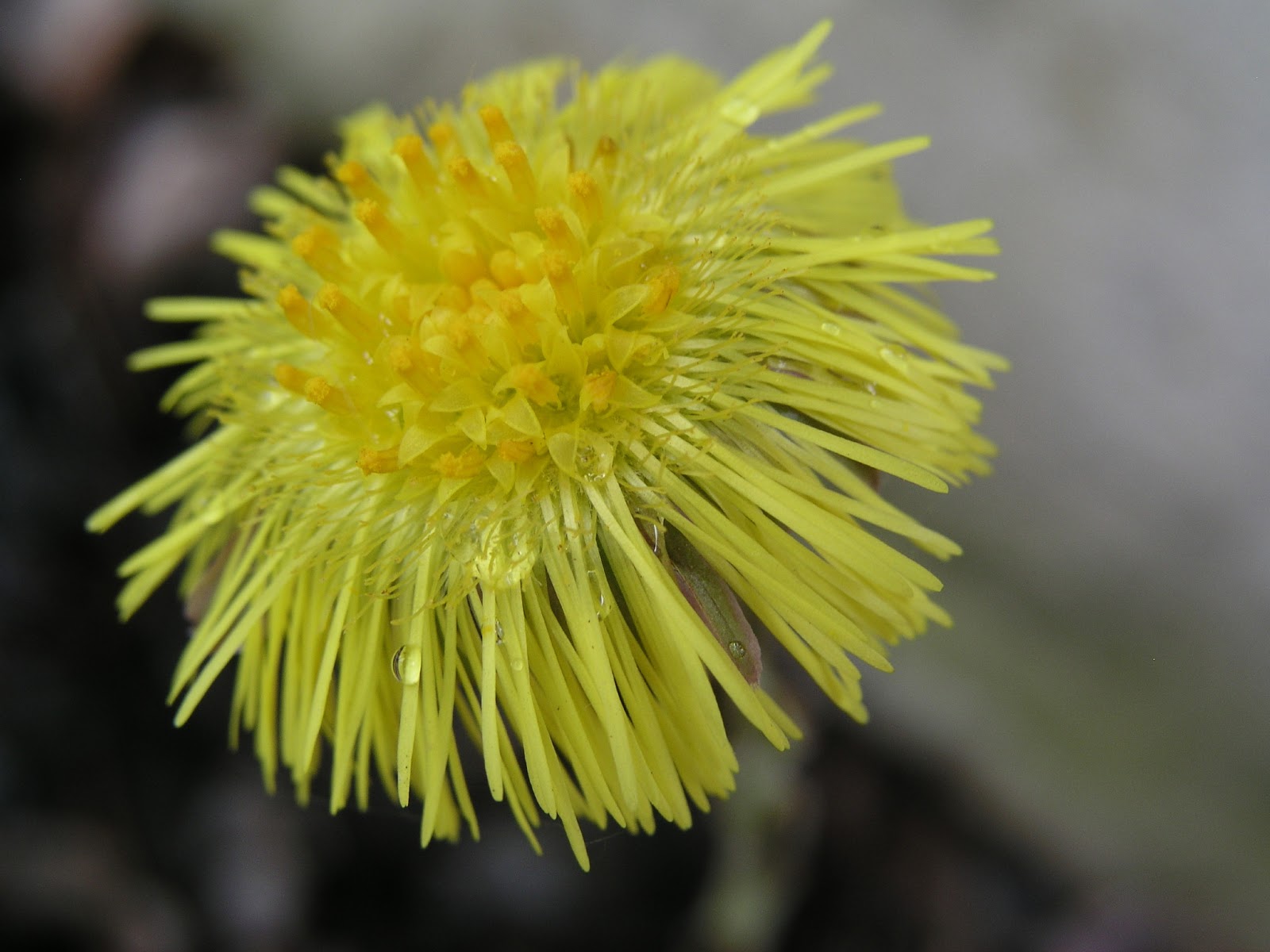
This charming plant, a member of the Aster family, is a naturalized immigrant from Europe. It is highly unusual in that its flowers appear before the leaves. As a result, many casual observers have been likely to mistake the leaves and blossoms as two separate plants. In fact, this plant has fooled even experts, for ancient botanists classified the flower as a leafless plant.
But leafless, it is not; and though tardy, the leaves are particularly lovely. They are large (5 -8 inches long, 3 -7 inches wide) stand erect, and are angularly lobed, resembling the shape of a colt hoof, hence its common name.  They are smooth and green, with prominent veins, and have a white, cottony underside. Often they appear just as the flower goes to seed: a white puffball, not unlike that of a dandelion.
Indeed, its yellow, composite flower has been likened to the dandelion, to which it is related. But unlike the dandelion, which is composed of only strap-shaped flowers, its flowers are composed of both ray and disk flowers. The leafless stems of the flower wear a downy fuzz and resemble asparagus, in that they bear red-tipped bracts.
The leaves grow from separate shoots on the underground rhizome. This rhizome, or rootstock, as well as the leaves, have traditionally been used for medicinal purposes.
The botanical name, Tussilago, means literally, cough dispeller, revealing the plant’s long history as a medicinal herb. In fact, early apothecaries used to display a picture of the leaf on their shop door, in order to alert the mostly non-reading public that they carried healing herbs, for its curative powers were widely known.
Coltsfoot contains flavonoids, which are anti-spasmodic and anti-inflammatory. The plant acts as an expectorant (helping to bring up phlegm) and as a demulcent (working to coat and soothe tissue) in fact, in Europe, it is one of the most widely used herbs for chest problems. While Europeans use mostly the leaf, the Chinese prefer the flower. However, the flower is much higher in pyrrolizidine alkaloids (one of the plant’s constituents) which may be toxic to the liver. In both countries the preferred plant part is made into a decoction ( where the plant is gently boiled to reduce the liquid, intensifying its potency.)
It is used as both a syrup for coughs, and as a cigarette for asthma. Also, research has shown that extracts of the whole plant increase the immune system.
Cautions: Do not use the flower, and do not take the leaves for over 3-4 weeks. Do not use if pregnant or nursing. Use for adults only. There are legal restrictions on the use of this plant in some countries.


Wednesday, February 13, 2013

Hieroglyphics of the Angels


-->
Hieroglyphics of the Angels

Wild Sarsaparilla (Aralia nudicaulis)

“Flowers have spoken to me
More than I can tell in written words,
They are the hieroglyphics of angels…”
Lydia M. Child

Color: Greenish white
Height: Up to 2 feet
Blooms: May- July
Habitat: Dry, open woods
Properties: Aromatic
Native

To encounter this plant in the woods is a delight! Its three, usually greenish-white flower clusters nod gracefully below a long, umbrella-like leaf, which is divided into three parts. Each leaf part is then divided into 3-5 finely toothed leaflets. The leaflets are a pale, yellow-green on top, and whitish-green below.
The three umbels are made up of tiny (1/4 inch wide) individual flowers, which consist of five white, folded back petals, and five green stamens. The flowers mature into black, or dark purple berries. The flowers and leaves are on separate stalks, but they actually are from the same stem, which branches close to the ground. The leaves are divided into 3-5 leaflets, 8-15 inches long. Sometimes there are as many as seven branches, with flower clusters on each stem, but most often, the flower stems and clusters appear in threes.
The plant has long, fibrous and fleshy roots that have been traditionally used as a substitute for genuine sarsaparilla (tropical Smilax) to make beverages.
The name sarsaparilla comes from the Spanish: zara, meaning “shrub”, and parilla, meaning, “little vine”.

Folk History
During the 1800s the roots of this plant were widely used as a blood purifier, and as a general tonic. In addition, it was also used as a poultice for sores, boils, burns, and itching.
An account written in 1785 by Rev. Manasseh Cutler, in a book about plants and their uses, describes Native Americans subsisting on the roots of this plant when on long hunting expeditions.
The Cherokee, Shawnee, and Menominee tribes all used the plant medicinally; it was used as a tea for back pain, for gas and flatulence, and for coughs and asthma, respectively. The Menominee tribe also used it as a remedy for blood poisoning.
Current Use
Many of its current uses were inspired by the wisdom passed on to early settlers by Native Americans, and almost all of its original uses are still employed today. The plant is a diaphoretic, which means that it encourages sweating, thereby being useful in treating fever. It is also detoxifying, and is used as a general tonic. It is an effective treatment for asthma, and coughs. In addition, it is typically used to treat rheumatism. Also, the plant’s historical use as a treatment for problems with the skin, such as eczema, continues today.
Caution: Do not take if pregnant.